May 8, 2006

Batastini Has Found Her Niche

By: Carolyn Thornton, Providence Journal Sports Writer
May 7, 2006

Basketball has taken Christina Batastini all over the world.

It took the former Classical All-American and New England Basketball Hall of Famer to the West Coast, where she played for Stanford, a top university with one of the country's best Division I programs.

Basketball also took her overseas, where she visited nearly a dozen countries and learned two new languages while playing professionally for four years against some of the best players in Europe.

And now, basketball has brought Batastini, 28, back to Rhode Island, where for the past 10 months, the Providence resident has been helping other young people build a solid basketball foundation, which just might help them create their own exciting opportunities.

"I'm doing this because I enjoy it and there's a need for it," said Batastini, who has created The Batastini School of Basketball.

Basketball was not the only area of excellence for Batastini, who was the 1996 Providence Journal Honor Roll Girl. She also earned All-State honors in cross country and track, and was named to both the Nike and Parade All-America basketball teams.

Even while she was playing pro ball in Italy, Norway, Sweden and Switzerland, Batastini had begun to realize how much she enjoyed working with young players through various basketball clinics she conducted in Europe.

Although she enjoyed serving as an assistant to Brown women's basketball coach Jean Marie Burr for the 2004-05 season after deciding it was time to bring her professional career to a close, it was becoming clearer to Batastini that she was meant to utilize her talents on the court in a different way.

Those talents and the direction she's taking them can be traced to being a 5-year-old sitting on the bench beside her father, Armand, watching him coach the St. Pius CYO teams. Batastini has seen the lasting impact her father has had on generations of players, and now she would like to do the same.

She began working with two sixth-grade boys who played for her father's team and were looking for some help on their games in the summer.

Then the phone started ringing as word got out that Batastini was providing individual instruction. In no time, she was working with 30 kids.

Last fall, she began conducting camps and clinics at various gymnasiums in Providence. Batastini is now also working with a number of Rhode Island College players and has been commissioned by Providence College coach Phil Seymore to work with some of the Lady Friars over the summer.

"It's just enjoyable working with the kids," she said. "It's fun to see the big difference I can make. I feel like I'm really helping them. My only goal is to make them better. I've embraced the idea that I can help a lot of players get to where they want to go."

Although she does work with boys, Batastini's client base has been primarily girls. And that's fine with her.

"I think that's going to be my niche," said Batastini, who feels strongly about including current and former Rhode Island female players on her staff to serve as role models. "I think it's important for the girls to be able to see someone like me or someone like Chelsea Marandola, [the Johnston All-Stater who just finished her rookie season at PC]. They need to be able to see females from Rhode Island who have gone on to be successful in college."

Batastini says that the one-on-one instruction she provides is something that most coaches simply don't have the luxury of doing when they are trying to manage a team of 10 to 12 kids.

She is amazed at how many youngsters lack the proper fundamentals, attributing some of the bad habits kids develop to shooting with "the wrong size ball at the wrong size hoop at a young age" and mimicking what they see the pros doing on television.

When working with a player, Batastini doesn't give them the ball until they have mastered a particular drill without it, and she won't let them shoot at a hoop until they have perfected their form.

"We go over and over it, and until someone can do something little, I don't introduce them to something more complicated," she said. "In order to move up, you have to have strong fundamentals."

Seeing some of her former Stanford teammates and classmates working on Wall Street, running start-up companies in California and becoming executives in the NBA, Batastini sometimes questions the career path she has chosen, wondering if she should be better utilizing her degree in American Studies. But ultimately, she comes to the realization that this is exactly what she should be doing with her life right now.

"Sometimes I ask myself, 'What am I doing?' " Batastini said. "But in the end, I wouldn't be happy without having basketball in my life. I always knew I would be doing something with athletics. It's just a part of me. I can't separate the two."

February 15, 2006

Steding Melds Faith, Action

By: Kerry Eggers, Portland Sports Tribune
February 10, 2006

Maybe it’s not her calling in life. At 38, there still may be a lot of twists and turns in her career. But there is little doubt that, for the time being, coaching the women’s basketball team at Warner Pacific College is the right move for Katy Steding. (More ...)

Stanford Women's Basketball Then and Now

By: Marian Burton Nelson

The phone rang. It was Fred Hargadon, Dean of Admissions. It was April 1974 and I had not yet accepted Stanford’s invitation to attend. I was an athlete, having played five different sports in high school and having led the Phoenix Dusters, a women’s amateur basketball team, to the Arizona State Championship. Though I had always wanted to go to Stanford, Cornell offered a much better athletic program for women in those days, so I was taking my time making up my mind. (More ...)

January 16, 2006

Whiting Honored for Great Career

By: Kevin Tresolini, Delaware News Journal January 12, 2006 When she left for Stanford University in 1989, Val Whiting was just 17 and not sure she was ready. It wasn't the cross-country move that most worried the Wilmington resident, but the physical demands of being a Division I college basketball player. "I remember like it was yesterday," Whiting said Wednesday. "I was scared out of my mind. They had given us these workouts to do during the summer, and I hadn't followed them. I thought I could play basketball every day to get ready, and that was my rude awakening. I remember going through that first two-mile [running] test and being lapped." Whiting got through that transition. She was named national freshman of the year while helping Stanford win an NCAA title. The 6-foot-2 center went on to become a two-time All-American, win another NCAA crown as a junior, and set school scoring and rebounding records. Recognition of that career came Tuesday when Whiting, 33, learned she had been named to the NCAA women's basketball 25th anniversary team by an ESPN.com panel. She is one of 25 players. Stanford coach Tara VanDerveer said she was thrilled to learn Whiting had been selected. "This recognition is well deserved for Val," she said. "The one thing that I know about Val is that the bigger the game, the better she played." The NCAA sponsored its first women's basketball championship in 1982, and the team is part of a season-long anniversary celebration. It also includes players such as Old Dominion's Anne Donovan, Connecticut's Rebecca Lobo and Diana Taurasi, Southern Cal's Cheryl Miller, Virginia's Dawn Staley and Texas Tech's Sheryl Swoopes. Among those who didn't make the 25-player cut is USC's Lisa Leslie, whose national team heroics surpass her collegiate accomplishments. But it does include Whiting, who led Ursuline Academy to four Delaware high school titles. "I was very surprised and definitely flattered, when you look at the group of people with me and who they left out," Whiting said. "It's the whole history of the NCAA [which had taken over for the Association of Intercollegiate Athletics for Women]. "This is amazing. I just wish my kids [sons J.J., 5, and Victor, 1] were a little older so they could understand." The only other Stanford player selected was Jennifer Azzi, a guard who was a senior during Whiting's freshman year and inspired her greatly, she said. "A lot of the women on that list I used to watch when I was in high school and they inspired me," Whiting said. "They were pioneers. They made me not feel weird because I was a girl and athletic or muscular or tall." Stanford was 114-16 during Whiting's four years there, and she remembers them fondly. Her 2,077 points and 1,134 rebounds set school marks. They have since been eclipsed, but she still is second on both lists. Whiting averaged 15.6 points and 10.1 rebounds in 16 career NCAA tourney games. Stanford also reached the Final Four in Whiting's sophomore year. Prior to her freshman season, Whiting had no such grand vision while enduring 6 a.m. swimming pool workouts at Stanford. "We had to get in the pool in full sweats and tread water," she recalled. "After a while, you figure out what's going on. Our goal was to win a national championship, and that was part of the preparation. "I got lucky that first year when two post players announced they were leaving, so there were just three of us - two players and me off the bench. I knew I was going to play no matter what. It was a great opportunity." And Whiting made the most of it. "You never know where you're going to stand when you get into that type of competition," said Reggie Whiting, Val's father, who now lives in Redmond, Wash., with her mother, Claudette. "But when the team did well and she did well that first year, it really gave her a lot of confidence that took her further as a player. It was really a turning point for Val." VanDerveer expected great things, believing Whiting would be just what Stanford needed after an NCAA regional final loss to Louisiana Tech the year before Whiting's arrival. "As we were leaving the gym I was distraught and said to my assistant, 'How are we ever going to beat a team like this?' " VanDerveer remembered. "She said, 'Val is coming next year.' The rest is history." After graduating from Stanford, Whiting played professionally in Italy and Brazil and at home in the American Basketball League and WNBA, last suiting up for the Minnesota Lynx in 2002. She played for the United States in international competition, such as the Pan Am Games, and was the last player cut at the 1996 Olympic Trials. Along with husband Jay Raymond, Whiting now lives in Wilmington and operates Game Shape, an athletic performance training facility on A Street near the Riverfront. She frequently attends high school games, especially those involving Ursuline, which now has another player, 6-4 sophomore Elena DelleDonne, who has gained national acclaim. Whiting relishes seeing so many young girls in the stands looking up to the high school players. "I miss being out there playing, but an honor like this makes it all worthwhile," Whiting said. "It makes you realize how blessed you were to have great teammates and great coaches."

December 27, 2005

Harrington Shares Her Knowledge

By: Steve Mathies, Herald and News, Klamath Falls, OR
December 25, 2005

She has always known that medical school would be part of her future.

It still is, but there are other degree programs to be completed first for Tara Harrington, Oregon's first high school All-American girls basketball player.

The affable Harrington has taken the fall term off to help with things at home. In January, she heads back to Chapel Hill, N.C., where she is set to receive a master's degree in business administration in June. A master's degree in health services looms in June of 2007.

“I still want to go to medical school,” she said while relishing the recent snow, something she had not seen since the winter of 1999-2000 when Harrington was an assistant women's basketball coach at Montana State University.

She might be “home,” but Harrington certainly is not taking life easy. She recently spent two days in Los Angeles securing a summer internship. She had hoped to attend the Tennessee at Stanford women's basketball game in November. She has been spending time helping Tom Loney and the Oregon Tech women's basketball team.

“I like the coaching part of basketball,” Harrington said. Her appearances at Danny Miles Court have helped eliminate the bitter taste she had after her experience at Montana State, where head coaches were changed between her two seasons there. It was a less than amicable split.

She smiles easily now. Her time with the Hustlin' Owls has helped. So has time with her parents, Len and Sue. Brother Ty, and his wife, were home for Thanksgiving, having traveled to Klamath Falls from Alabama.

Her father said before a December OIT game that he thinks his daughter relishes coaching. “This has been fun, just a lot of fun,” Harrington said after the Hustlin' Owls beat Evergreen State and hand the Geoducks their first conference loss of the season.

Tara Harrington still carries herself with the grace that helped her, and her Mazama teammates, begin to put Southern Oregon Conference on the girls state basketball map. The Vikings placed twice when Harrington played, including a third-place finish after a semifinal loss to power Oregon City, something no other SOC girls basketball team ever had done. The Vikings also played in tournaments in New York City and in Ohio.

Harrington then left for Stanford, where she was able to use basketball to get an education.

Her collective basketball exploits helped whet her appetite for travel. She drove to a pair of recent road games, both OIT wins. During November and December, she has taken notes, made little suggestions and made new friends. “It's been great and the girls really respond to her,” Loney said recently. “The girls look up to her. They respect her. Everybody will miss her.”

“I really like her helping out,” sophomore Ashley DuBrey, who played high school basketball at Triad, said. “It's always nice to have another coach.”

Senior Samantha Gilbert, who played high school basketball at Klamath Union, said: “She knows everything and is really helping us reach our potential. She has been a big help.”

Loney said Harrington has been a nice additional to the Owls this fall. “She brings a lot to the table,” the fourth-year OIT women's coach said. “She helped add a new wrinkle to our offense, which was something she ran at Stanford. “It's been nice having a female on the staff, giving us ideas about the game I don't know. She has helped both the players and the coaches.” More than being another coach, however, is the role Harrington plays. “She's such a strong person. She's a good role model,” DuBrey said. Loney said: “Everybody will miss her.”

Harrington said leaving the Oregon Tech women's basketball program will be, on the one hand, sad, but, at the same time, she looks forward to her future.

December 20, 2005

E-Mail #2 from Kate

We reached .500 with our first road win of the season. We played in Ligo, a town on the northwest coast of Spain whose ocean inlets and evergreen trees always manage to remind me of Seattle and make me homesick even in the most present of mental states.

Our team actually didn't stay in Ligo this year, but found a hotel in Pontevedra, about 40 kilometers away, instead. The Vigo hotels were all filled to capacity with the competitors and fans for an around-the-world regatta that began on Saturday afternoon. Our game began at about the same time. Jamila lamented this unfortunately poor timing of events, unable to catch more than a seconds-long peek through a taxi window at the amazing ships lined up and ready to race. She is a sailing aficionado. We noticed the intricate masts of some pirate-like models as we drove into the city, and Jamila's initial gasp of awe ended up a swallow of disappointment as our gym-bound taxi dove into a tunnel and carried us away from the port.

We don't take buses very often, unless the trip between airport and hotel or gym is more than an hour's drive. Instead, we pile into southern European-sized taxis four, often sweaty, northern European-sized chicas. It is not the most comfortable ride, especially when the high-pitched, old sweat stink of never-dry basketball shoes drifts forward from the bags in the trunk.

Six of us opted to take our dinner outside the hotel, and spent the evening wandering the very cold streets of Pontevedra searching for a tapas bar with enough room for half a basketball team. When we finally found the proper combination of table size, stool size, and heat, we ended up ordering three bottles of wine and a serving of everything on the menu. We munched on Spanish tortilla, calamari, croquetas, sausage, shrimp, and three types of octopi, with just about all of it soaked in oil.

We deserved a feast. Our week had been a bit dramatic, with the coaches and "directivos" having alternately taken away all of our human rights and then returned most of them with a new written set of team rules. As a thirty-year-old it seems a bit strange to be given an in-week curfew and bedtime by men who I am not even related to, and I'm glad they worked most of that out without me having to speak or habla-up.

By the end of the week our team rules allowed, once again, for us to be free to do as we pleased with our post-game weekend. We just have to make sure to ask for permission. Okay, I guess I can deal with that indiginity, as long as it's not accompanied by curfews and check-ins.

In the magazine that sits in the seat pocket under the tray table on every Iberia flight, there are a few pages that list all of the current cultural exhibits in every city in Spain. I like the magazine, because it has all of the articles in Spanish and English, so I can expand my vocabulary during the flights. A few weeks ago, Jamila noticed a Frida Kahlo exhibit running in Santiago de Compostela. She had an easy time talking Katja and me into another prospective journey. When she asked for permission to change our homebound flights, our coach remarked, "Ester wants to stay and see her boyfriend. You all want to stay and be culturally enriched..." He consented, of course.

So we spent our pre-game nap time in an internet cafe re-working our flight itineraries and re-checking the exhibit time. On Sunday morning, as the rest of the team was cabbing back to the airport, we were walking to the Pondevedra bus station down a dark and icy street, with our big, red, smelly gym bags slung over our shoulders.

You forget about cold when you cease to experience it in any direct way. It hits fifty here sometimes at night and with our heat still not working the sixty degree temps inside can be a bit uncomfortable. But I have my sweatshirts and my hats, and winter sort of disappears into the palm trees here in Ibiza.

Winter does not, however, disappear into the palm trees in Santiago de Compostela. We arrived in a sub-zero bus station at 9 in the morning. The sun was barely above the horizon. The sky was blue, mostly, with a few hazy clouds racing by overhead. The wind was biting. We observed that our bulky team jackets were merely big but not warm. I put a fuzzy ski-cap on my head and we set out to find the first of many coffees (cola-caos for me).

We took the right city bus into town, but missed our stop and ended up hiking a kilometer or two back into the city center. Jam limped along on her sore ankle and my back began to call attention to itself. Active basketball players don't necessarily make the best back-packer style tourists.

As we made our way into the city center, we noticed that nature was somehow defying its own laws. With a perfectly clear sky overhead, it was somehow snowing. We cackled a bit at our fortune in witnessing such a miraculous event in this city of miracles. Santiago de Compostela is the city at the end of the Camino, a hundreds-of-kilometers long route of pilgrimage for French and Spanish Catholics. Since the Middle Ages, the road has been traversed by pilgrims seeking spiritual growth in their quest to behold the purported remains of Saint James. Apparently, the bones of the great "Moor-killer" were discovered by a hermit in 813 AD through an angelic revelation. Since then, the town has reaped the rewards of a booming tourist industry during various ages, including our own.

Our pilgrimage this time around had another focus, and we skipped most of the Compostela sights, although I did snap a few shots of the Church and a large crowd "manifesting" in the square below it.

We were in the front of the line when the Frida exhibit opened at noon. The lay-out of the exhibit was exceptional, with rooms filled with general information about her life, photos of her and Diego Rivera, and several pieces of her work, including some from a private collection that is rarely open to the public. It was hard, however, to come face to face with such personal torture in canvas after canvas. The whole experience was very moving, and my words could not begin to do it justice so I will shy away from any further description.

We took our lunch in a building just a few meters from the exhibit's exit. Not long after that, we headed off, on foot, back to the bus station to retrieve the bags we'd left in lockers there and then made it to our afternoon flight back to Ibiza.

I feel so lucky to be able to experience Spain in small installments, one weekend, one exhibit at a time, and in between have a nice soft bed and real-life schedule to exist inside. I came home and crashed, slept ten hours, then woke up and began the life-tasks of laundry washing and hanging, grocery shopping, downloading pictures, and emailing all of the people I left at home. I wonder what I'll be writing home about next Monday...

Letter Home from Kate

Kate Starbird sends us the following note... Jamila Wideman is on the point guard. It's typical Wideman defense. The ball handler is having a bit of trouble. Again. She tries to cross over and it's a... steal. STEAL, WIDEMAN.

She has the ball now. She's crossing mid-court. Kate Starbird is streaking down the right lane. She has a step on her defender. Wideman sees her and fires a pass up the court.

LAY-UP, STARBIRD. ASSIST, WIDEMAN.

It may all seem quite familiar, a replay from a worn-out cassette or a nostalgic memory, until the announcer breaks through the cheers and lifts the veil of time.

CANASTA. ESTA-BEERD. ASSISTENICIA. ZHAMEELA WEEDAMIN.

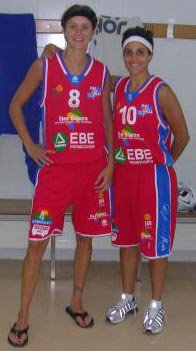
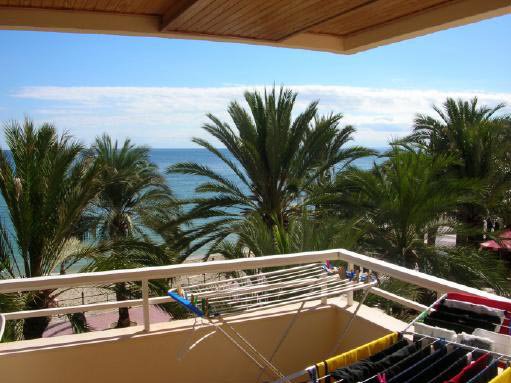
The uniforms are red, but not cardinal. The numbers on the back aren't quite right. Our trusty ponytails, Jamila's and mine, are absent. Instead, we both wear goofy-looking headbands to hold back our now-short hair. That streaking motion down the lane wasn't quite as lightning fast as it used to be, and Jamila's foot fire doesn't mesmerize with such a high frequency. We're not 21 anymore. In fact, we're not even in our twenties. We're both 30 and we're in Spain. Jamila survives on a bottle of Advil, while I opt out of every other practice, substituting pool work-outs and hour-long stretching sessions in instead. Jam holds her team huddles in Espangles. I yell out "bloqueo" when she's about to get nailed by a screen. We're a long way from Stanford, in both time and distance. But, I still have my old knee-pads, though they are a bit more hole-y now, and Jamila still drives the opposing point guard up the wall with her smothering defense, which I now recognize as 100% pure effort. And we're still playing this game we love so much. We live in Ibiza, Spain and play for a club called, "Puig D'en Vals." Our town, Santa Eularia, is about 20 kilometers north of Ibiza city. It is a tourist town, and pretty darn quiet now that the summer season has ended and the German and British sun-seekers have all packed up and gone home. Our apartment sits over the now empty boardwalk and our balcony looks out onto the Mediterranean. A few palm trees offer the only obstruction to our view. Through our open windows, we can hear the waves hit the small stretch of beach below.

The situation is close to being both perfect and poetic, two former Stanford teammates reunited on a court in an island paradise. I can't say I ever imagined my life turning out exactly like this, but I offer up no complaints. Who could?

I can't pretend to know exactly how or why Jamila ended up here with me, but I know why I'm here. Luck. Amazing luck. And luck that I didn't always recognize as good until I began to sit back and enjoy the ride I've been on since I showed up for my first day on the Stanford campus, limping. This game has been a journey as well as its boat. It has introduced me to amazing people and transported me all over the world. It has directed me and defined me, pushed me down and picked me back up again. I have allowed it to take me to great heights and suffered when it let me fall. I have cursed it and called it ugly names. At this moment, watching a thunderstorm release its fury on my idyllic Ibician horizon, I recognize it all as a road that led me here, both in physical and mental space, and I know that this game has been one of the great gifts of my life, and I am thankful for both the journey and the very moment I have.

We have practice tonight at 7. It should be pretty tough, because we lost this weekend. We'll warm up, stretch (and I take that oh-so-seriously now), then run our legs off for almost two hours. Afterwards, we'll be drenched in sweat from the combination of effort and the soupy, wet air in the gym. My t-shirt will actually be soaked through, my lungs sore from the burn. I'll stop off for a massage in the training room, a daily necessity for my old, aching back. It will be after 10 before I get home. I'll make myself a quick dinner and write a few emails home. Then I'll hit my bed and fall asleep to the sound of the waves rolling into the shore.

I am 30 years old and still playing basketball for a living in Ibiza, Spain. Not a bad deal.

-- Kate